Artist Statement & Biography
Artist Statement
Paul Robinson’s photographs explore how images shape our experience of space, presence and memory. Working across panorama, portraiture and digital image-making, he uses photographic processes to draw the viewer into scenes and unsettle familiar ways of seeing.
The market panoramas made in Madagascar and Vietnam are conceived for monumental, billboard-like display. Stalls, goods, figures and boats stretch across the frame, drawing the eye into a dense field that resists a single point of focus. In West Texas, the austere structures of Donald Judd and Elmgreen & Dragset’s Prada Marfa appear within a landscape shared with cattle, roadside buildings and vernacular references to cinema. Art, local life and the open terrain occupy the same visual field.
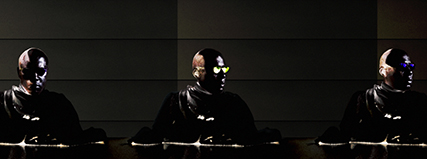
The Portrait Series likewise attends to the encounter between subject and setting: gaze, posture, light and place shape each portrait, while oblique angles and blur leave room for ambiguity. In Young Man 1–4, inversion, fragmentation and collage bring the physical presence of a young Black man to the fore. The sequence challenges fashion imagery that can reduce Black men to styling or spectacle, presenting instead the beauty, vitality and individuality of youth.
Room In Negative Space uses the photographic negative to reveal aspects of an interior that ordinary sight may overlook. Reversed tones, divisions and repetitions draw attention to the room’s edges and spatial relationships. In the Germany series, a gas-mask viewpoint and curved panorama make the Dachau chamber disorienting. The mask suggests protection while limiting vision; the chamber evokes the wider system of Nazi gas chambers, making the act of looking uneasy and mediated.
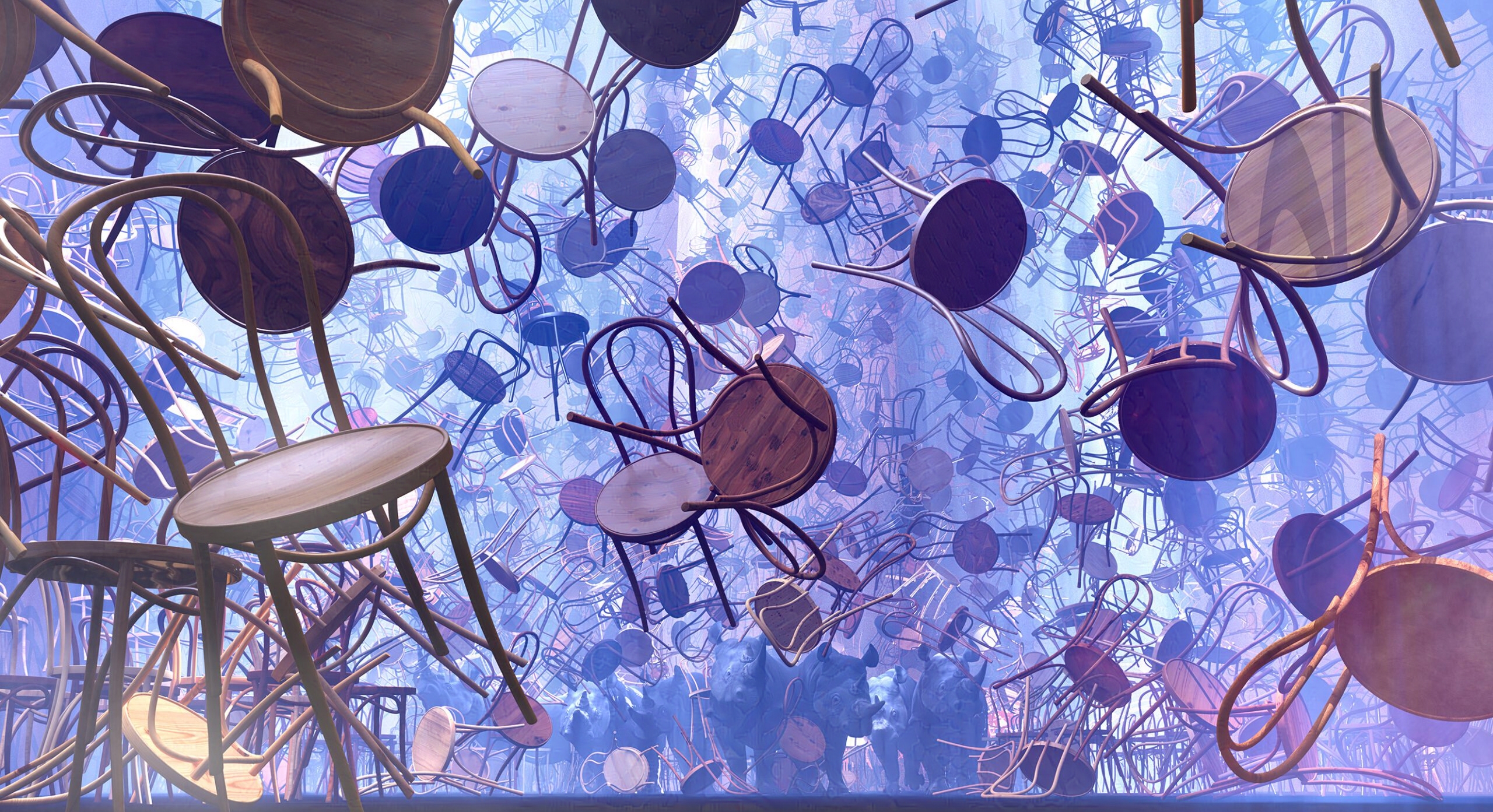
In the 3D & AI works, saturated colour, layered forms and 3D-based processes create constructed visual worlds. Some draw on Eugène Ionesco’s plays The Chairs and Rhinoceros, translating their instability into digital images.
Biography
Born in Huddersfield, West Yorkshire, Robinson studied photography at Batley Art College (1978–1982). His career in commercial fashion, advertising and editorial photography took him from London to the Netherlands and Germany. He now lives and works in Augsburg, where his independent practice develops through photographic projects across Europe, Africa, Asia and the United States.
Selected Works & Series Overview
I. Portraits & Self-Portraits
This practice area gathers approximately thirty-three portraits and self-portraits that trace a line from studio-based fashion and character studies through to experimental negative portraits and more introspective self-representations. The work focuses on the relationship between the human figure, constructed light and the camera’s point of view, often negotiating a tension between staged presence and unguarded observation.
Historical and contemporary model releases are being reviewed and consolidated so that future books, exhibitions and institutional presentations can be curated in line with legal and ethical best practice. The portraits presented publicly represent a carefully selected subset of the wider body, aligned with this ongoing rights and archival work.
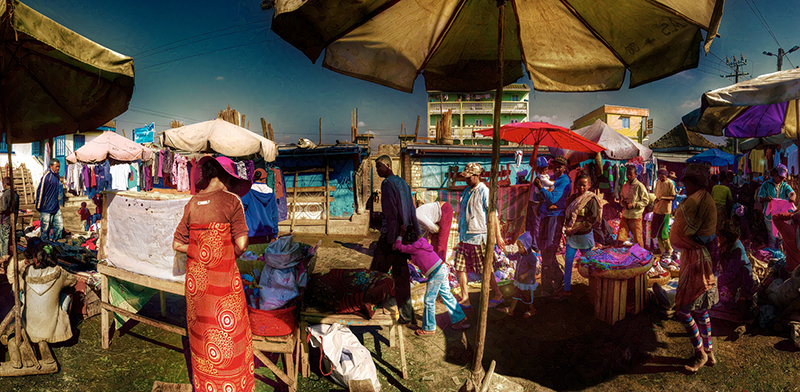
Open Market, Antananarivo City, Madagascar, 2023
Approx. 121 works
View Series
II. Otherlands: Territories & Threshold Spaces
Under the working heading Otherlands, this area comprises roughly one hundred and twenty-one images that investigate markets, streets, peripheries and border spaces as sites of lived experience. Many works employ a panoramic method that compresses a 360-degree view of the public sphere into a single, expansive tableau where numerous individual stories intersect.
The technique creates a sense of “stagnated movement”, allowing the viewer to experience a continuum of moments held within one frame. Over time, the Otherlands material will be structured into distinct series by geography, atmosphere and motif, and integrated into the catalogue raisonné and archival projects elsewhere on this page.
III. Still Life & Experimental Photography
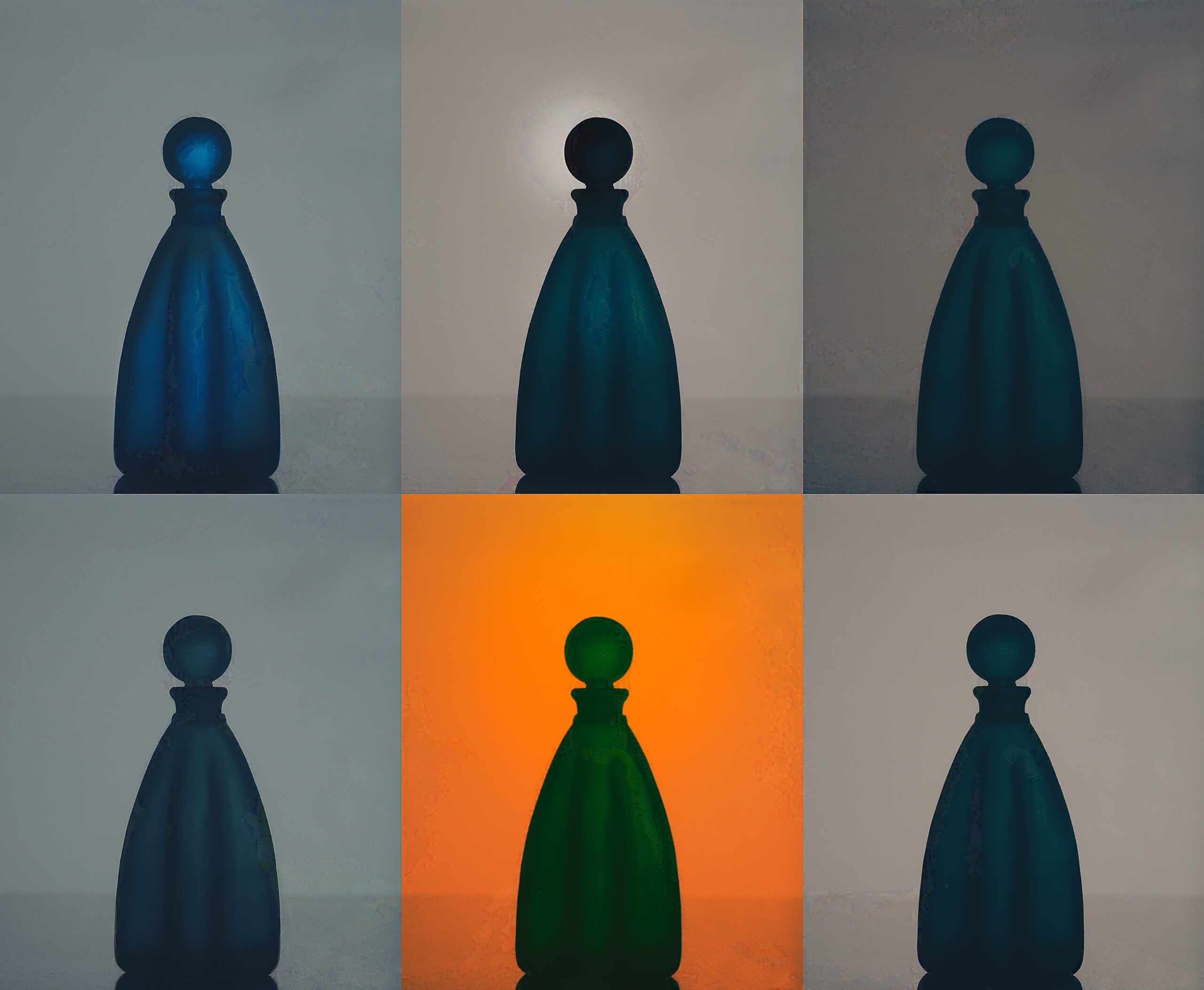
This group of approximately fifty-seven works includes still-life studies, perfume-bottle arrangements, glass experiments and darkroom or digital tests that explore material, surface and light. The photograph functions here as a controlled laboratory: objects are isolated, lit and recomposed to emphasise reflection, transparency, colour shifts and the sculptural qualities of everyday forms.
Many of these images operate as technical and conceptual research for larger projects, bridging commercial still-life discipline and personal experimentation. They are an important reference point for the ongoing interest in the photographic negative as an autonomous object and in the translation of analog aesthetics into digital printing and post-production.
IV. The Computational Narrative: 3D & AI-Driven Allegory
The 3D and AI illustration practice currently comprises around fourteen works, including the politically charged G7 series and related digital allegories. These images are built in 3D software and AI-assisted workflows, but lit, framed and graded with the logic of studio photography, creating hybrid constructions that sit between photograph, sculpture and illustration.
Rather than treating AI and 3D tools as ends in themselves, this work uses them to stage narratives about power, history and representation. The resulting images are integrated into the same archival, editioning and rights framework as the analog and digital photographic works, and are recorded accordingly in the artist’s internal registry and catalogue raisonné in preparation.
Bibliography & Publications
In Progress/Under Construction.
Exhibitions & Commissions
In Progress/Under Construction.
Collections & Provenance
In Progress/Under Construction.
Awards & Residencies
In Progress/Under Construction.
ARCHIVAL MATERIAL
Catalogue Raisonné (In Preparation)
The artist is preparing a catalogue raisonné, a comprehensive scholarly record of all accepted works by Paul Robinson. The catalogue will document each work with title, series, date, medium, dimensions, edition and impression numbers (where applicable), provenance, exhibition history and key publication references.
The project covers the full span of practice, from early commercial and fashion photography through panoramic market scenes, experimental negatives, still-life studies and 3D/AI-based works such as the G7 series. Source material includes studio records, negative and print inventories, contracts, condition reports, exhibition checklists and institutional archive entries. Each work is cross-checked against the artist’s internal registry and, where available, supported by certificates of authenticity and conservation notes.
The underlying registry and detailed catalogue data are not published online, but may be shared in excerpt form with qualified institutions, galleries, archives, researchers and collectors on request, for provenance verification, due diligence and exhibition planning.
Enquiries regarding the catalogue raisonné can be directed to info@das-unit.com.
Conservation & Print Standards
A statement on the archival quality of the materials used, such as paper type, inks, and mounting techniques. It also provides guidelines for the proper care, handling, and conservation of the physical prints.
Digitisation & Metadata Standards
An overview of the technical standards used for digitizing analog works and the metadata schemas (e.g., IPTC, Dublin Core) used to catalog and describe each image file, ensuring data consistency and searchability.
Archival Timeline
A detailed, chronological history of the artist's career, including key milestones, projects, exhibitions, and life events. This provides a comprehensive reference for researchers and historians.
Institutional Partnerships & Archives
A list of official partnerships with universities, museums, libraries, or other institutions that are involved in archiving or studying the artist's work.
Digital Preservation & Archival Policy
This practice maintains a dedicated digital and physical archive to safeguard the long-term accessibility, authenticity and integrity of the artworks and their associated documentation. The goal is to ensure that master materials remain usable and verifiable for future exhibitions, publications, scholarly research and institutional collections.
Master Files, Negative Scans & Source Materials
Master files (high-resolution digital originals), negative scans (from analogue film) and associated metadata are treated as primary archival assets. These materials are preserved in their highest available quality, without destructive compression or unnecessary alteration. Any working copies prepared for web, print or editorial use are derived from these master assets and are clearly separated from them in the archive.
Archival Formats, Fixity Checks & Versioning
Master files are stored in stable, widely recognised archival formats (for example, TIFF or equivalent preservation-grade formats for images, and open or well-documented standards for associated documents). Fixity checks (e.g. checksum verification) are performed at regular intervals to confirm that files have not been corrupted, altered or degraded over time. Versioning practices are applied: when significant adjustments or conservation edits are made, new versions are created rather than overwriting existing masters, preserving a clear history of changes and provenance.
Redundant, Encrypted Backups in Separate Regions
The archive is stored using redundant backup strategies, with at least two independent copies of core materials maintained in separate physical or geographic locations to mitigate the risk of loss through hardware failure, accident or disaster. All backups containing original or sensitive data are encrypted and protected by appropriate access controls, in line with professional standards of digital security and privacy. Backup media and systems are reviewed and renewed periodically to avoid dependence on obsolete hardware or unsupported storage technologies.
Metadata Standards & Discoverability
Descriptive, technical and administrative metadata are recorded using recognised standards such as IPTC and Dublin Core, where applicable. Metadata includes, as far as practicable: artwork titles, dates, locations, techniques, materials, editioning information, rights information, exhibition history and relevant contextual notes. The aim is to support accurate cataloguing, search and discovery across collections, and to provide curators, researchers and institutions with reliable contextual information about each work.
Institutional Custodians & Conservation Standards
Where works or digital masters are entrusted to museums, galleries, archives, libraries or other institutional custodians, those institutions are expected to meet professional conservation and collection management standards appropriate to their field. This includes, for physical works: appropriate environmental controls, handling protocols and storage conditions; and for digital materials: secure, redundant storage, documented preservation policies and responsible migration to newer formats or media when required.
Institutional custodians are expected to maintain the integrity of both the work and its metadata, and to consult the artist or rights holder (or their representative) regarding any significant conservation interventions or format migrations, where practicable. This policy is intended to ensure that the body of work, together with its documentary record, remains authentic, traceable and accessible over time, for the benefit of collectors, institutions and future audiences.